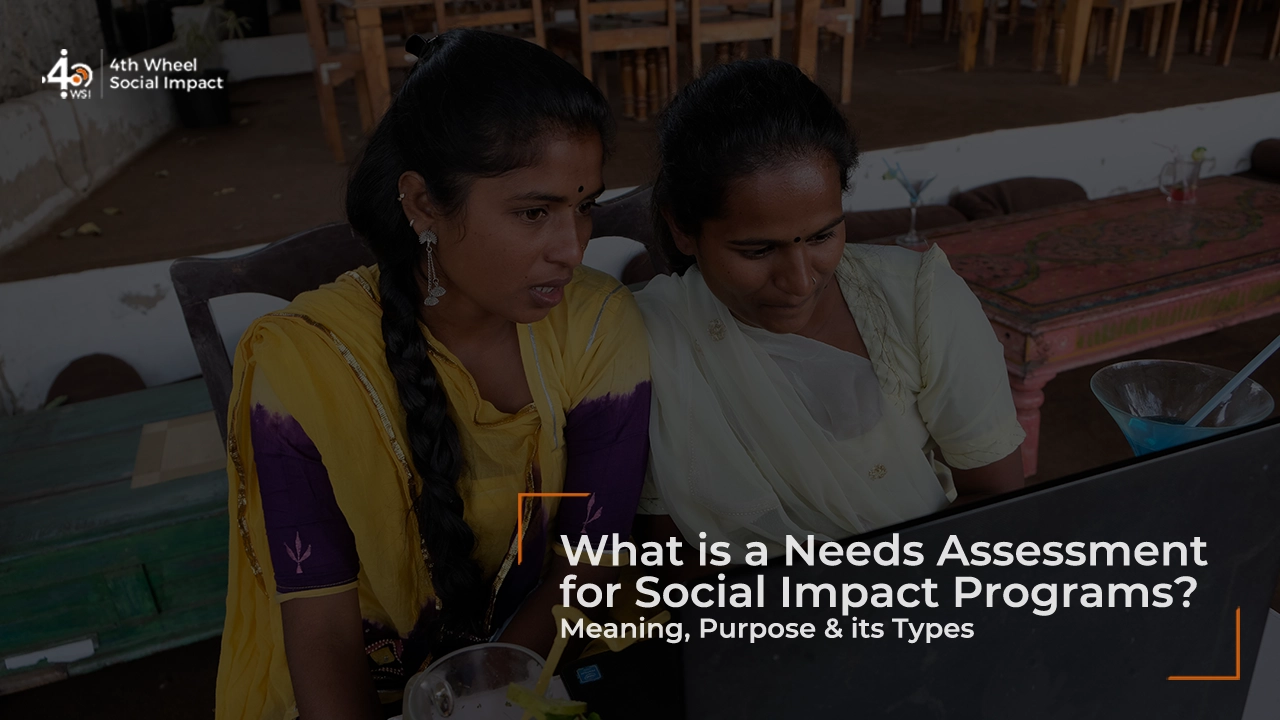
For any social impact program to be effective, it must address the genuine needs of the community it serves. A needs assessment exercise helps to close this gap through social, economic, and political evaluation.
Needs assessment vary across different communities. A thorough needs analysis allows social impact firm to examine closely the lives of the people they intend to serve. This helps organizations understand the problems and their specific context. A well-conducted needs evaluation also helps in setting priorities and making programs more efficient in the long term.
What is Needs Assessment Meaning?
Understanding the needs assessment meaning is crucial for social impact organizations. A needs assessment is a systematic process of identifying the barriers faced by communities in attaining social, economic, or political well-being.
The assessment’s meaning goes beyond identifying problems. It includes conversations with communities to understand their lives, tracing factors that lead to the final problems, and mapping available resources. A needs assessment study also helps in developing sustainable solutions. It makes sure that the voices of marginalized groups are included, preventing programs from overlooking critical perspectives.
For example, your organization may plan to boost nutrition in children but later learn that food shortages are not the problem. Instead, it may be found that children are not carrying tiffin boxes to school because the severe heat in their region spoils food quickly. This leaves them hungry for long hours or causes them to avoid school altogether. Based on this finding, the program shifts from providing food to providing technology for food preservation.
What is the Purpose of a Needs Assessment?
Needs analysis helps social impact management organizations address important challenges by identifying root causes as well as context. Social impact organizations can strengthen their programs with needs assessment studies. The purpose of conducting a thorough assessment is to ascertain that social impact programs fulfil the following goals
1. Focus on real problems
Needs assessment identifies the exact problems that the community is facing through several methods such as focus group discussions and interviews. It eliminates all the other factors that may create hurdles in effectively understanding the problems.
2. Targeting the right population
It helps to see the community with a closer lens and identify the most marginalized people in the community or in a given geography. This helps to shift the focus from a larger population to the ones who need interventions the most.
3. Evidence-based solutions
A thorough needs assessment study helps to collect the right data and evidence about the communities and hence, creating solutions that are not based on assumptions but on evidence.
4. Efficient use of resources.
Needs assessment studies help with understanding the areas that require resources such as funds, staff, and partnerships. It helps to determine areas where the resources will have the most impact.
5. Creating a visibility for all factors affecting a particular community
For a social impact program to be successful, it’s important to conduct a baseline assessment and identify factors that affect the community. Identifying these factors helps the organisations to tailor their impact programs for every community’s unique problems and stay accountable to communities.
Types of Needs Assessment in Social Impact

A strong needs assessment approach begins with understanding the specific gaps, priorities, and conditions that influence organizational performance. Different methods help leaders study internal capacity, stakeholder expectations, program relevance, and workforce skills with clarity.
The different types of needs assessments used today result in varied outcomes. Each type of needs assessment brings a distinct lens, and together they create a detailed picture of what an organization must strengthen to achieve long-term stability and measurable social value.
Organizational Needs Assessment
An organizational needs assessment examines internal systems, decision pathways, performance challenges, and structural constraints. It supports leaders in reviewing whether existing processes match strategic intent, how teams distribute responsibility across functions, and where current monitoring & evaluation capacity may be limiting long-term effectiveness. Needs assessment in organizations identifies gaps in capability, communication flow, and accountability practices. With this understanding, organizations gain direction on resource allocation, operational refinement, and future planning. It forms a foundation for informed, realistic improvement initiatives.
Community Needs Assessments
A community needs assessment focuses on the people and environments affected by an organization’s work. It brings forward insights on priorities, resource gaps, and barriers that communities experience. Findings help teams understand what support is relevant, how engagement should be structured, and which social outcomes require attention. This process strengthens alignment between program design and real-world needs. The resulting clarity improves trust, partnership potential, and long-term relevance within community settings.
Programmatic Needs Assessments
A programmatic needs assessment evaluates the suitability, reach, and effectiveness of specific initiatives. It reviews goals, activities, participant feedback, and expected outcomes to determine where design changes may improve program results. By studying needs assessment surveys, relevance, and operational flow, organizations understand which elements require reinforcement or revision. Through this assessment, programs respond to stakeholder expectations and organizational priorities. It is an essential tool for refining interventions and improving their long-term feasibility.
Training Needs Assessments
A training needs assessment identifies capability gaps across teams and organizational levels. It examines skill requirements, role expectations, performance challenges, and growth opportunities. This helps leaders determine what skill training is necessary to strengthen workforce confidence and productivity. The study makes sure that learning investments reflect what employees actually need, not assumptions about their abilities. Clear insight into workforce capability allows organizations to plan structured learning pathways and strengthen internal performance systems.
Participatory Needs Assessments
A participatory needs assessment involves stakeholders directly in identifying needs, priorities, and possible solutions. It relies on guided dialogue, facilitated workshops, and collaborative decision-making to build a shared understanding of challenges. This method increases ownership among participants because insights emerge from their lived experience. Organizations benefit from richer data, stronger relationships, and greater acceptance of future actions. It supports inclusive planning and leads to solutions grounded in stakeholder reality.
Check our case study on needs assessment: Adani Greens CSR: Needs Assessment in Maharashtra
Core Components of a Needs Assessment
Core components of a needs assessment are both practical and impactful. Following are three such important components of needs assessment that support well-informed decision-making:
1. Relevance
Relevant needs assessment tools establish the process that addresses actual gaps and priorities rather than assumptions. By identifying what matters most to the target population, organizations can design programs that respond to real challenges. Relevance also prevents wasted resources and strengthens trust between communities and organizations by showing commitment to meaningful impact.
2. Participation.
Involving stakeholders and communities in the needs assessment process is necessary to capture diverse perspectives. When community members are active participants, they help highlight cultural, social, and local realities often missed in top-down approaches.
3. Accuracy
Accuracy depends on using reliable data and systematic needs evaluation methods deliver credible and valid findings. This involves triangulating data from multiple sources, reducing bias, and verifying information to reflect actual conditions.
Case Study: Effective Needs Assessment in Action

4th Wheel Social Impact conducted a rapid needs assessment study for AM Foundation that wanted to address health problems in Chennai and Tiruvallur districts of Tamil Nadu. A participatory approach was used with qualitative methods for data collection, including semi-structured interviews, observations and transect walks, resource mapping templates, and checklists.
Vulnerability analysis was conducted to identify the 14 most vulnerable clusters from the 52 areas in the two districts through this comprehensive needs evaluation.
Through this needs assessment study, 4th Wheel identified several factors that severely affected the communities, such as high prevalence of waterborne diseases and existence of co-morbidities such as hypertension and diabetes. Multiple issues were observed in accessing health facilities, including poor roads and infrastructure. The community also had limited doctors and overburdened staff. Most facilities had poor infrastructure and limited service offerings, requiring people to travel long distances to get appropriate healthcare.
Based on the detailed needs assessment results, specific recommendations targeting the community’s problems were provided to AM Foundation. This case shows how evidence-led planning can transform vague assumptions into clear and effective action steps.
Conclusion
Needs assessment is not simply about problem identification. It’s about aligning social impact programs with community realities. When the needs assessment process is done well, it affirms that interventions are relevant, equitable, and sustainable.
By grounding decisions in evidence and community voice through needs analysis, social impact organizations can design programs that create meaningful, lasting change. Understanding the true needs assessment meaning and implementing effective needs evaluation processes are fundamental to successful community development initiatives.
At 4th Wheel Social Impact, we conduct thorough needs assessments and vulnerability studies. Contact us to learn more about our monitoring, evaluation, accountability and learning services.
FAQs
What are the techniques of needs assessment?
The techniques of a needs assessment include surveys, focus groups, stakeholder interviews, direct observations, and secondary data reviews. These methods help organizations understand community priorities and challenges. Selecting the right approach depends on the context and goals of the program. Using multiple techniques often gives a more accurate picture during the needs assessment process.
What is the importance of a needs assessment?
A needs assessment is an important pre-requisite for any impact study because it identifies gaps between current conditions and desired outcomes. It guarantees resources are allocated effectively, avoids duplication of efforts, and strengthens program design. For nonprofits, it builds credibility with funders and stakeholders.
Who needs a needs assessment?
Needs assessments are used by nonprofits, governments, businesses, and community organizations. Nonprofits use them to design programs, governments to plan policies, businesses to improve training and services, and communities to voice their priorities. Anyone aiming to solve a problem, improve performance, or create social impact benefits from conducting a structured needs assessment process or needs evaluation.
What tools can be used in a needs assessment?
Tools for needs assessment include surveys, questionnaires, checklists, interviews, participatory rural appraisal tools, and data analysis software. These tools help collect and interpret information effectively. The choice of tool depends on the types of needs assessment being conducted, such as organizational, training, or community-based. A mix of qualitative and quantitative tools often provides deeper insights during a needs evaluation.
What is the difference between a needs assessment and a needs analysis?
While often used interchangeably, a needs assessment and needs analysis differ slightly. A needs assessment identifies and prioritizes gaps, while a needs analysis goes deeper to understand root causes and possible solutions. For example, a training needs assessment focuses on identifying skills gaps, while a needs analysis explores why those gaps exist and how they can be addressed effectively.